

Design for Development
English Literacy in Thailand
Design driven by change and improvement in Thai education, focusing on English literacy through a research-based, competency-based curriculum.
Project Overview
This project was developed in response to persistent gaps in English literacy and digital skills within Thailand’s education system. While access to schooling is nearly universal, national and international assessments consistently show that many Thai students struggle with foundational reading, writing, and communication skills, particularly in English. These challenges begin early and compound over time, limiting students’ academic progress, confidence, and future opportunities.
Using national policy documents, international benchmarks, and classroom-based research, this project resulted in a competency-based English curriculum designed to begin in Grade 1 and progress systematically through primary education. The curriculum shifts away from topic-based memorization toward mastery of essential skills such as phonics, decoding, vocabulary, grammar, reading comprehension, writing, speaking, and communication. By grounding learning in clear progressions and threshold concepts, the curriculum ensures that students build strong foundations from the earliest years, setting them up for long-term success in English literacy.
Problem Statement
The lack of a standard educational system
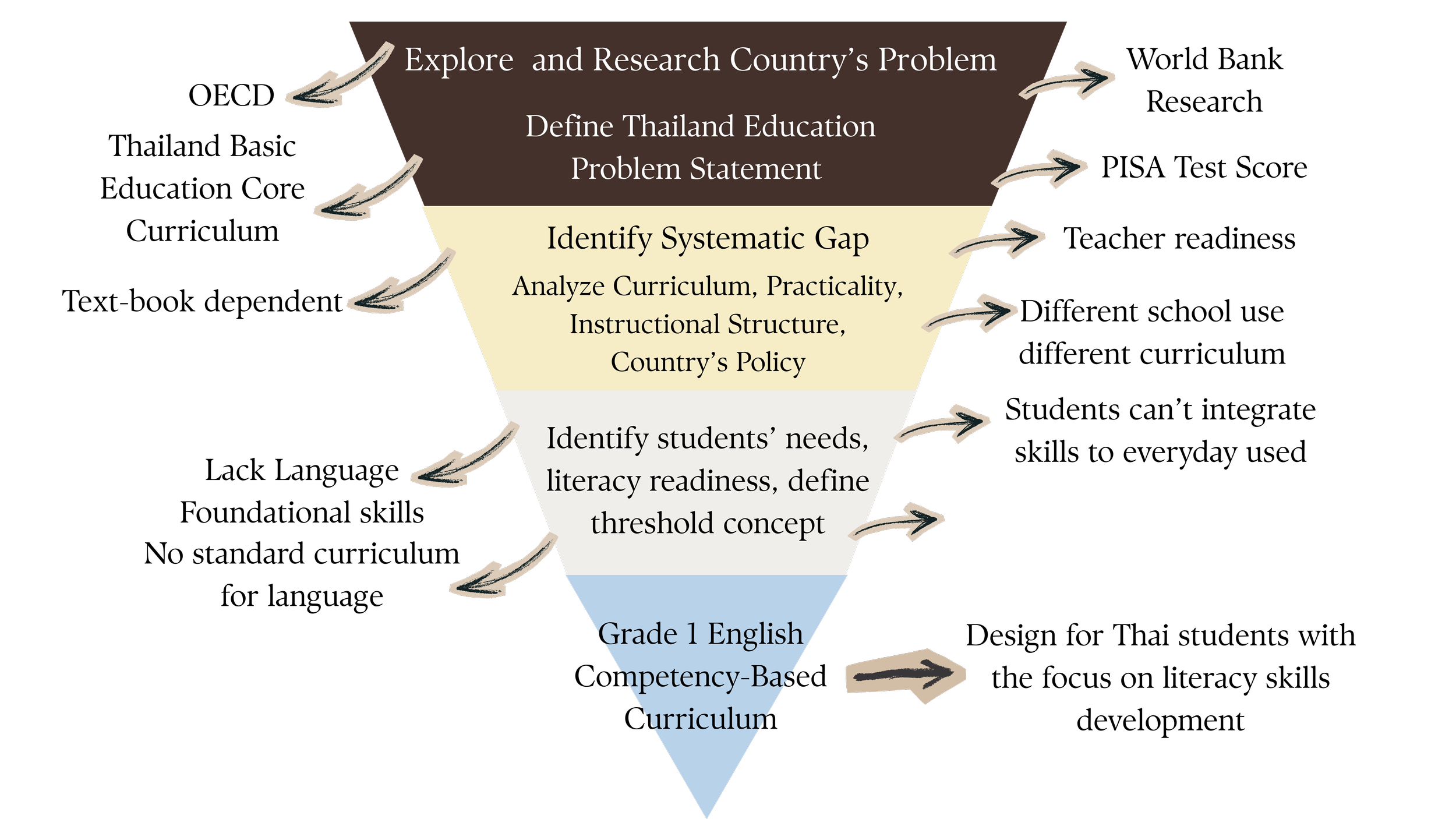
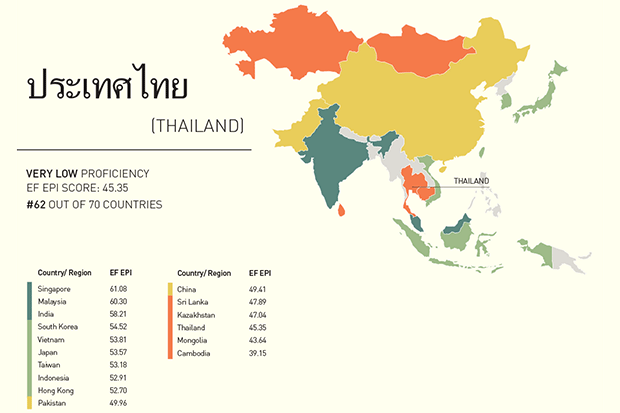
Thailand’s education system has achieved near-universal enrollment, yet learning outcomes tell a different story. National and international data reveal that a significant number of students do not reach basic reading proficiency, even after years of English instruction. English is taught as a foreign language with limited exposure outside the classroom, while the national curriculum provides broad standards without clear year-by-year skill progression. As a result, teachers often rely on textbooks, students memorize content without understanding how language works, and foundational literacy gaps remain unaddressed.
These challenges are not the result of low effort or motivation. They stem from system-level design issues related to curriculum structure, assessment alignment, and teacher support. Without a clear, research-based pathway starting in the early grades, students struggle to decode, comprehend, and communicate effectively in English.
.
Key Issues Identified
-

Low Foundational English Literacy Skills
-

Curriculum Lacks Clear Profression
-

Lack Readiness and Capacity Gaps
-

Assessment and Learning Misalignment
Why Systemic Change Is Needed
The challenges facing English literacy in Thailand cannot be solved through isolated fixes such as new textbooks, extra tutoring, or short-term teacher workshops. The problem is structural. Students move through the system without securing foundational skills, teachers work without clear progression guides, and assessments often reward memorization rather than meaningful language use. When gaps appear early, the system lacks mechanisms to identify and repair them before they widen.
Systemic change is needed because foundational literacy is cumulative. If students do not master decoding, vocabulary, and basic sentence structure in the early grades, later instruction becomes ineffective, no matter how much content is added. Without a curriculum that clearly defines what mastery looks like at each stage, learning remains inconsistent across classrooms and schools.
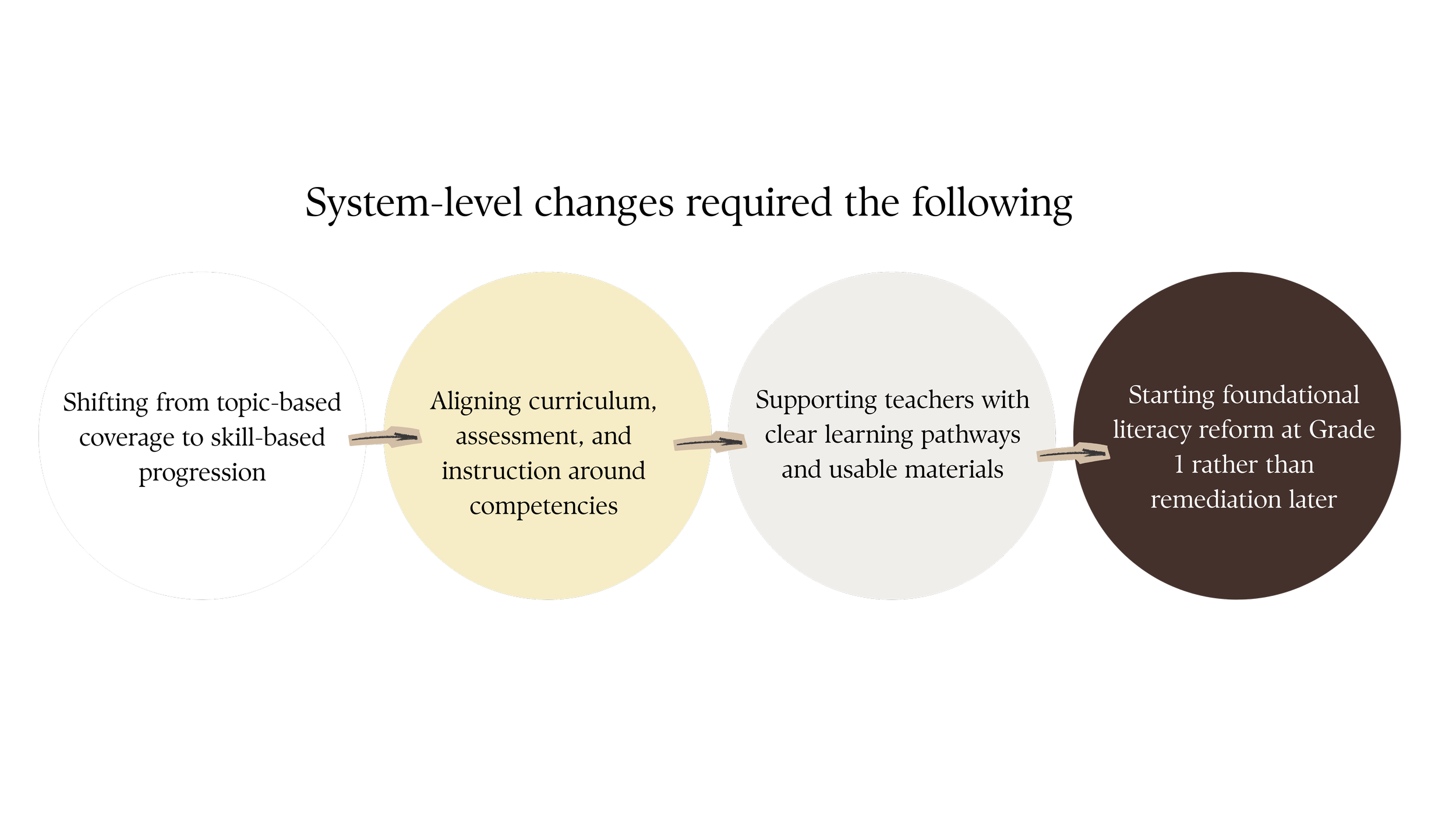
A system-level approach is required to realign how English is taught, learned, and assessed from the beginning. This means redesigning the curriculum around competency progression rather than topic coverage, supporting teachers with usable learning pathways, and ensuring that assessment reflects real language ability. Only through systemic change can Thailand move from surface-level learning to lasting English literacy that supports equity, confidence, and long-term success.
Threshold Concepts Application in the Curriculum
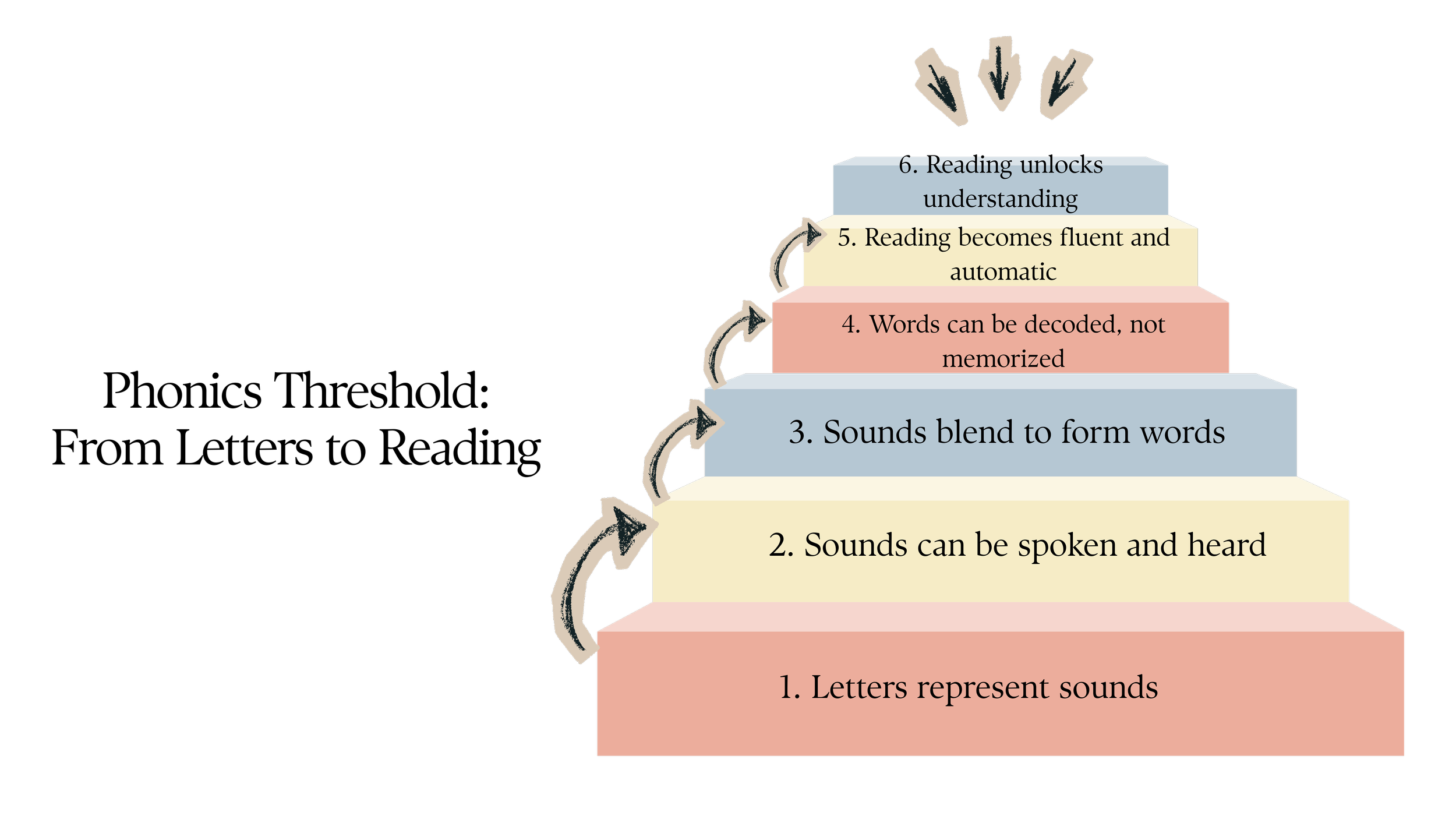
Threshold concepts are the moments when learning “clicks.”
They are the key ideas and skills that permanently change how students understand and use language. Once a student crosses a threshold, learning becomes easier, deeper, and transferable across contexts.
In this project, threshold concepts shape the entire curriculum. They determine what students must truly master at each stage before moving forward, ensuring that learning is cumulative rather than fragmented.
What This Means for Thai Students
For Thai learners of English, threshold concepts include understanding that letters represent sounds, sounds combine to form words, grammar expresses meaning and time, and reading and writing are tools for thinking rather than memorization. When these thresholds are crossed early, students move beyond copying and guessing. They begin to read with understanding, write with purpose, and communicate with confidence.
This approach prevents gaps from forming, reduces confusion, and replaces frustration with visible progress. Learning becomes meaningful, irreversible, and empowering.

What Is a Competency-Based Curriculum
A competency-based curriculum focuses on what students can do, not how long they sit in a classroom. Progress is based on demonstrated mastery of skills rather than memorization or fixed timelines. Learning goals are clear, assessments measure performance, and students receive feedback until mastery is achieved.
In this project, competency-based learning means students actively show their English ability. They decode unfamiliar words, read with fluency, write clearly, and speak with purpose. Success is measured through real language use rather than recall-based tests. This approach is especially effective for English literacy, where true learning only happens through application.
-
Students know exactly what they are expected to learn and demonstrate at each stage. Learning goals are specific, visible, and tied to real skills, so progress is transparent for students, teachers, and families.
-
Learning is organized around building skills step by step rather than covering topics by grade level. Students move forward only after mastering foundational competencies, ensuring learning is cumulative and secure.
-
Students show what they can do with their knowledge through reading, writing, speaking, and real tasks. Success is measured by application and understanding, not by recalling isolated facts or rules.
-
Students receive ongoing, targeted feedback and opportunities to improve until mastery is achieved. Mistakes are treated as part of learning, supporting confidence, persistence, and long-term growth.
Plan of Action: Pilot Phase
The next phase of this project is a Grade 1 pilot program in a private school in the south of Thailand. This school will serve as a sandbox environment where the curriculum can be implemented, observed, and refined in real classrooms.
Students will receive ten hours of English instruction per week. Five hours will focus on phonics, reading, and writing to secure foundational literacy. Five hours will focus on listening, speaking, and communication to build confidence and functional language use. This balanced structure ensures that decoding and comprehension develop alongside meaningful communication from the very beginning.
Insights from the pilot will inform pacing, assessment design, and teacher support, with the long-term goal of scaling the curriculum to additional grades and schools.