


When Research Wins, Teaching Loses in PhD Training
Doctoral education prioritizes research excellence while neglecting pedagogical training — a systemic challenge that resists simple solutions and demands a paradigm shift.
The Problem: Pedagogical Neglect in PhD Training
Doctoral education is designed to produce researchers, not educators. Teaching is often treated as intuitive, secondary, or something graduate students will “pick up along the way.” As a result, many PhD students are placed in classrooms without formal preparation in pedagogy, assessment, or inclusive practice.
This is a wicked problem because it is systemic, self-reinforcing, and rooted in institutional reward structures. Tenure, promotion, and prestige continue to prioritize research output, making teaching reform difficult to sustain through isolated training or optional programs.
Redesigning Doctoral Education
What Is a Wicked Problem?
A wicked problem is complex, systemic, and unsolvable through linear fixes — every attempt to solve it reshapes the problem itself.
No Single Solution
Teaching preparation looks different across disciplines, institutions, and student populations.
No Stopping Rule
Each generation of faculty reproduces the same training gaps they experienced.
Conflicting Values
Research productivity is rewarded; teaching excellence is sidelined.
Systematic Roots
The problem reflects deeper academic reward structures, not individual failure.
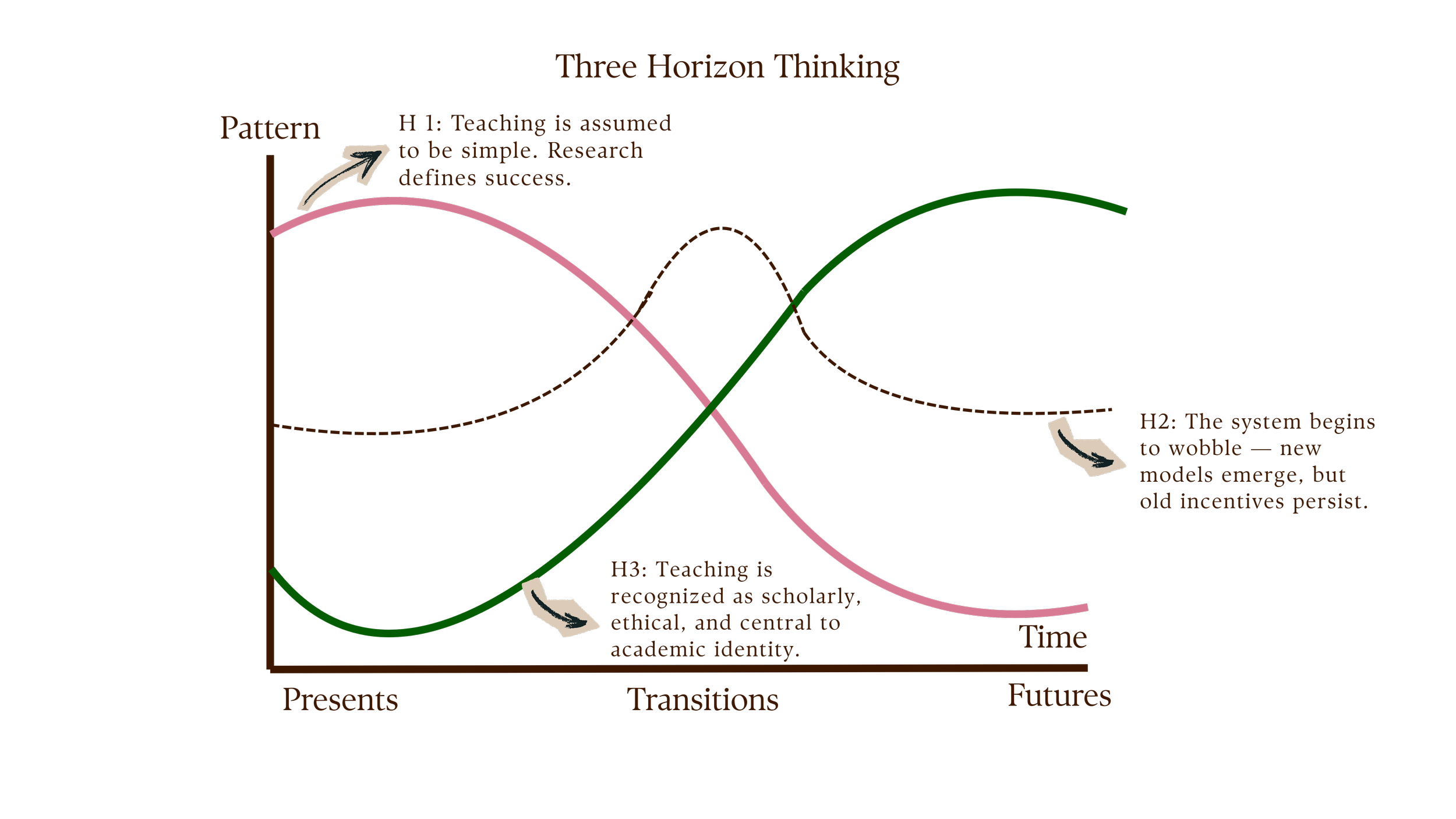
The Three Horizon of Change Framework
-
Research defines academic success. Teaching is undervalued, undertrained, and often invisible in evaluation systems.
Research output = prestige
Teaching treated as secondary or “natural”
Little formal pedagogical training
Tenure & promotion reinforce imbalance
-
H2 – The Transition Zone
Disruptors such as teaching certificates, CIRTL, and Departmental Action Teams introduce pedagogical development, but cultural resistance and misaligned incentives limit their impact.CIRTL & DATs
Teaching certificates
Data-informed student success metrics
Feedback loops
Cultural resistance
-
Teaching is recognized as scholarly, learnable, and central to academic identity. Pedagogy, data-informed student success, and equity become embedded across doctoral training—not added on.
Teaching = scholarly practice (SoTL)
Faculty identity includes care & inclusion
Pedagogy embedded across PhD training
Teaching, research, and service rebalanced
Redesigning doctoral education requires systems-level alignment, not quick fixes. Sustainable change happens when:
Teaching is valued alongside research and service
Data is used to demonstrate student success and institutional impact
Cultural values shift toward care, inclusion, and educational stewardship
This transition reframes teaching as a core responsibility of academic life—essential to student learning, faculty identity, and the public mission of higher education.
What This Change Requires
Systematic Level Change
Sustainable change requires more than adding teaching workshops. This redesign calls for systemic alignment—where institutional values, incentive structures, data-informed decision-making, and academic culture work together. By embedding pedagogy into doctoral training, evaluation, and faculty identity, teaching shifts from an optional add-on to a core responsibility of higher education.
Summary
This project addresses the gap in pedagogical training in PhD programs by treating it as a wicked problem, not a skills deficit. Doctoral education has historically prioritized research, leaving teaching undervalued and underdeveloped. Using the H1–H3 curve framework, the redesign maps the dominant research-centered paradigm (H1), the current transition space of experimentation and tension (H2), and an emerging future where teaching is recognized as scholarly, learnable, and central to academic identity (H3).